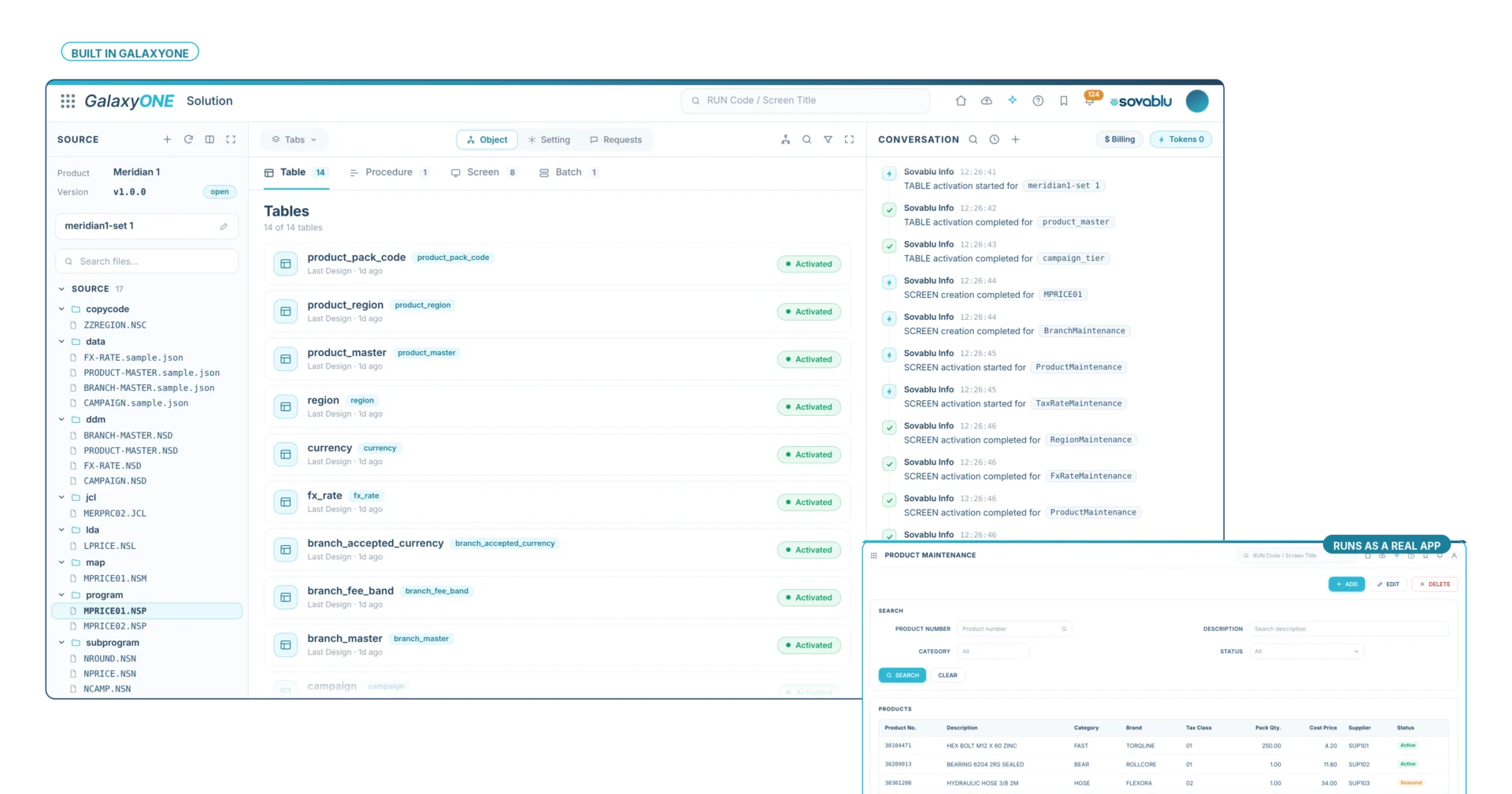
GalaxyONE: the AI engine inside Sovablu
GalaxyONE hero two panel diagonal 1

Generic AI writes code.

GalaxyONE builds systems.

GalaxyONE is the AI engine inside the Sovablu platform. Bring a plain-language idea, a stack of specs and sketches, or an entire legacy system. GalaxyONE builds the complete application: data, logic, screens, and workflows, as a governed, visual system your team owns and changes in plain language. Nothing arrives as code you have to maintain.

Zero

Lines of code written by your team

Days

From idea to deployed application

80%

Faster time-to-market vs conventional development

20x

Faster legacy migration with GalaxyONE

60%

Lower development & operations cost

The architecture

One engine. Four Copilots. Specialized agents underneath.

You give direction to GalaxyONE. Each Copilot owns a domain of the build and deploys its own specialized agents. The Solution Copilot keeps the whole application consistent.

Galaxy0NE LightBlue

ONE ENGINE

Solution Copilot

Holds the whole application together. Coordinates the build across every domain and keeps every part consistent.

Data Copilot

Owns the data model. Reads table and database design documents, generates and maintains your tables.

Logic Copilot

Builds business logic from natural language. Every output lands in the Logic Designer, ready to refine.

Layout Copilot

Generates interfaces from samples, wireframes, screenshots, or hand-drawn mockups, into the UI Designer.

Seven ways in

Give it the parts. It builds the whole.

Whatever exists today is a valid starting point. A specification, source code, screenshots of a system nobody documented, a database, a spreadsheet the business depends on, or a description in your own words. Every one of them ends in the same place.

02 pattern A specification 2 600
You have a specification

The document is already organised the way the engine works. Master data becomes the data model, rules become logic, screens become layout.

You give
Functional specification, database design, wireframes or mockups.
02 pattern B source code 2 1200
You have the source code

Where a system was never documented, the code is the record. Behaviour nobody remembers is still in it, and still running the business.

You give
COBOL, RPG, AS/400, Visual Basic, Oracle Forms, Lotus Notes, aging Java, Access with VBA.
02 pattern C screens 2 1200
You have the screens, not the source

Source is often unavailable rather than missing. Compiled only, held by a vendor, or out of contract. The running system can still be read.

You give
Screenshots, screen recordings, exported reports, a walkthrough with a working user.
02 pattern D database 2 1200
You have the database

Where a system is a data store with a thin interface over it, the schema carries most of the structure and a share of the rules.

You give
Schema, keys, relationships, database design documents.
02 pattern E spreadsheet 2 1200
The system is a spreadsheet

A complete system with no governance around it. The logic is written in the formulas, and the business already trusts the output.

You give
Excel workbooks with macros, Access databases, the departmental tools that became essential.
02 pattern F no system 2 1200
There is no system yet

GalaxyONE builds from your description and asks wherever it is unclear or contradicts itself. Changes afterwards are made in plain language too.

You give
A description of what the business needs, in your own words.
02 pattern G mixed sources 2 1200
You have some of each

This is what most estates look like. Several sources can be supplied together for one system, and where they disagree GalaxyONE raises the conflict rather than choosing silently.

You give
Source for part of it, an older specification, screenshots of the rest, the spreadsheet that fills the gap.

How it works, end to end

Bring what you have. Deploy in weeks.

Most enterprise projects start with a blank page and a specification exercise. GalaxyONE starts with the material you already have, specifications, screenshots, spreadsheets, or the legacy system itself, and returns a deployed application in four to eight weeks. From that point your business team changes it in plain language, without waiting for a developer.

01 · Bring what you have
Your existing source data

No blank page and no rewrite from scratch. What already describes your business becomes the input.

Specifications
Screenshots
Excel files
Source code
Table designs
Mockups
02 · GalaxyONE builds it
One engine, four Copilots

Each Copilot owns a domain of the build and deploys its own specialized agents underneath.

Solution
Data
Logic
Layout
03 · What you get
A deployed application

Data model, screens, logic, and workflows running as one governed system. Changeable in plain language, with no maintenance debt handed to your engineers.

mock app window simple

SCOPE

Convert all of it, or one agreed phase at a time.

A single system is usually built in one pass. A large estate is split into phases. The scope of each phase is agreed before it starts, and the output of that phase is limited to that scope.

The whole estate goes in once and stays in context from then on. Every phase is built against that complete picture, so what it produces connects correctly to the parts that have not been built yet.

03a phase 1
03b phase 2
03c phase 3

Dashed outline: your whole estate, held in context throughout. Solid teal: what that phase builds.

Your current system

Replace it, run alongside it, or leave it where it is.

What happens to the system you run today is usually decided long before any vendor arrives. All four options are supported.

Replace it
04 boundary replace

The new system takes over and the old one is retired.

Run both for a while
04 boundary run in parallel

Both take the same inputs. Nothing switches over until the numbers agree.

Move in phases
04 boundary move in phases

The old system shrinks rather than switching off. Each phase is approved on its own.

Leave it and build around it
04 boundary extend around

The system you will not move stays where it is. The systems around it are built and connected.

How you work with it

Three steps. In plain language, start to finish.

Specifications
Screenshots
Excel files
Source code
Table designs
Mockups
Describe it, or upload it

Plain language is enough to start. Or bring what you have. GalaxyONE maps the relationships between all your sources.

mock step2 dialogue
Validate by dialogue

When the logic or business workflow is ambiguous, GalaxyONE stops and asks rather than guessing, then builds accurately on your answer. Continuous validation runs throughout.

mock galaxyone refine 2 600
Refine in plain language

Changes propagate across the system automatically. Anything needing judgment is surfaced as a review for your approval.

What it generates

Every object an enterprise application needs. Yours to review and change.

Not code fragments. Each object arrives complete and open: inspect it, trace how it behaves, change whatever does not match the way your business actually works, then deploy. Nothing goes live until you say it should.

Tables
Screens
Logic
Batch jobs
Reports
Components
Procedures
Workflows

Where the output lands

Everything arrives visible and editable, never as opaque code.

GalaxyONE does not hand you code to assemble. It generates into the three designers your team already builds with, so everything it produces is visible, editable, and owned from the first minute.

UI Designer
Screens

Component palette, canvas, and full attribute control. Every component’s attributes, styles, and events stay editable.

Screens from the Layout Copilot land here.

mock designer ui
Data Designer
The data model

Tables, columns, types, and relationships, with per-column governance for keys, audit, encryption, and localization.

Tables from the Data Copilot land here.

mock designer data
Logic Designer
Business logic

Flowcharts assembled from Sovablu Actions such as CASE, IF, ASSIGN, CALL_SUB, CALL_API, and CALL_AI.

Flows from the Logic Copilot land here.

mock designer logic
Each designer is a professional development environment, not a simplified editor. What GalaxyONE generates arrives as the same editable objects your team would have built by hand, which is why a business team can keep changing the system without a developer.

The difference

AI code generation gives you output.
GalaxyONE gives you a system.

Dimension
Sovablu GalaxyONE
AI Code Generators
What you get
A complete application with all required elements - UI, logic, database
Source code
Who can change it
Your business team, in plain language
Developers only
Design alignment
Design and application stay aligned automatically
Code drifts from the design over time
Validation
Continuous validation before anything goes live
Issues surface after deployment
Governance
Built into the platform from day one
Manual setup, per project
Ownership
You own and manage the outcome - complete control
You own the risk and the maintenance challenges

Frequently asked questions

GalaxyONE, answered.

What is GalaxyONE?

GalaxyONE is the AI engine inside the Sovablu enterprise no-code platform. It builds complete enterprise applications through a set of Copilots, each of which deploys specialized agents. You bring your existing assets, such as legacy source code, specs, and sketches, and GalaxyONE builds a working system your team owns and can change in plain language.

Do I need existing code or systems to use GalaxyONE?

Not necessarily. A plain-language description is enough to start. GalaxyONE also builds new applications from the design materials a new system typically starts with: mockups, wireframes, screenshots, system specification documents, and database design documents. Legacy source code and other existing assets are only needed when you want to rebuild a system you already run.

What are Copilots and agents in GalaxyONE?

A Copilot owns a domain of the build: the Solution Copilot holds the whole application together, the Data Copilot owns the data model, the Logic Copilot builds business rules, and the Layout Copilot designs interfaces. Under each Copilot, specialized agents carry out focused tasks such as schema design or interface layout. You give direction to GalaxyONE, and the Copilots coordinate the agents.

What kinds of systems can GalaxyONE build?

Full enterprise systems: ERP, supply chain management, manufacturing execution, CRM and dealer management, HRM, warranty and service management, warehouse and logistics, finance and expenses, helpdesk and ticketing, and more. It also rebuilds legacy systems from Microsoft Access, Visual Basic and VBA, COBOL, IBM Lotus Notes, RPG, Oracle Forms, Excel workflows, and SAP custom modules.

How is GalaxyONE different from AI code generation tools?

Code generation tools output source code as text and leave you to maintain it, so edits drift from the design and only developers can make changes. GalaxyONE produces a complete visual application with UI, logic, and database, keeps the design and the application automatically aligned, and lets anyone make changes through plain-language chat, with continuous validation catching issues before activation.

What happens when I change something?

GalaxyONE handles the propagation of a change across the system automatically. Anything that needs your judgment is surfaced as a review and a next action for you to approve, so you stay in control of what ships. When two sources conflict, GalaxyONE asks you rather than guessing.

Can I bring my legacy system?

Yes. You can bring legacy source code, specifications, sketches, and folder structures as starting material. GalaxyONE maps the relationships between them, asks you in real time where sources are unclear or conflict, and builds a coherent design and application from them.

See Sovablu in Action.

Ready to see what your teams can build with Sovablu? Let's start with a conversation.