Security on Sovablu is not a checklist applied after the fact. It is the architecture. Every layer of the stack has a defined owner, every access decision is recorded, and everything GalaxyONE generates lands inside the same governance as everything your team builds by hand.
Enterprise security fails in the seams, where each party assumes another is covering a layer. Sovablu removes the seams by defining exactly who is responsible for what.
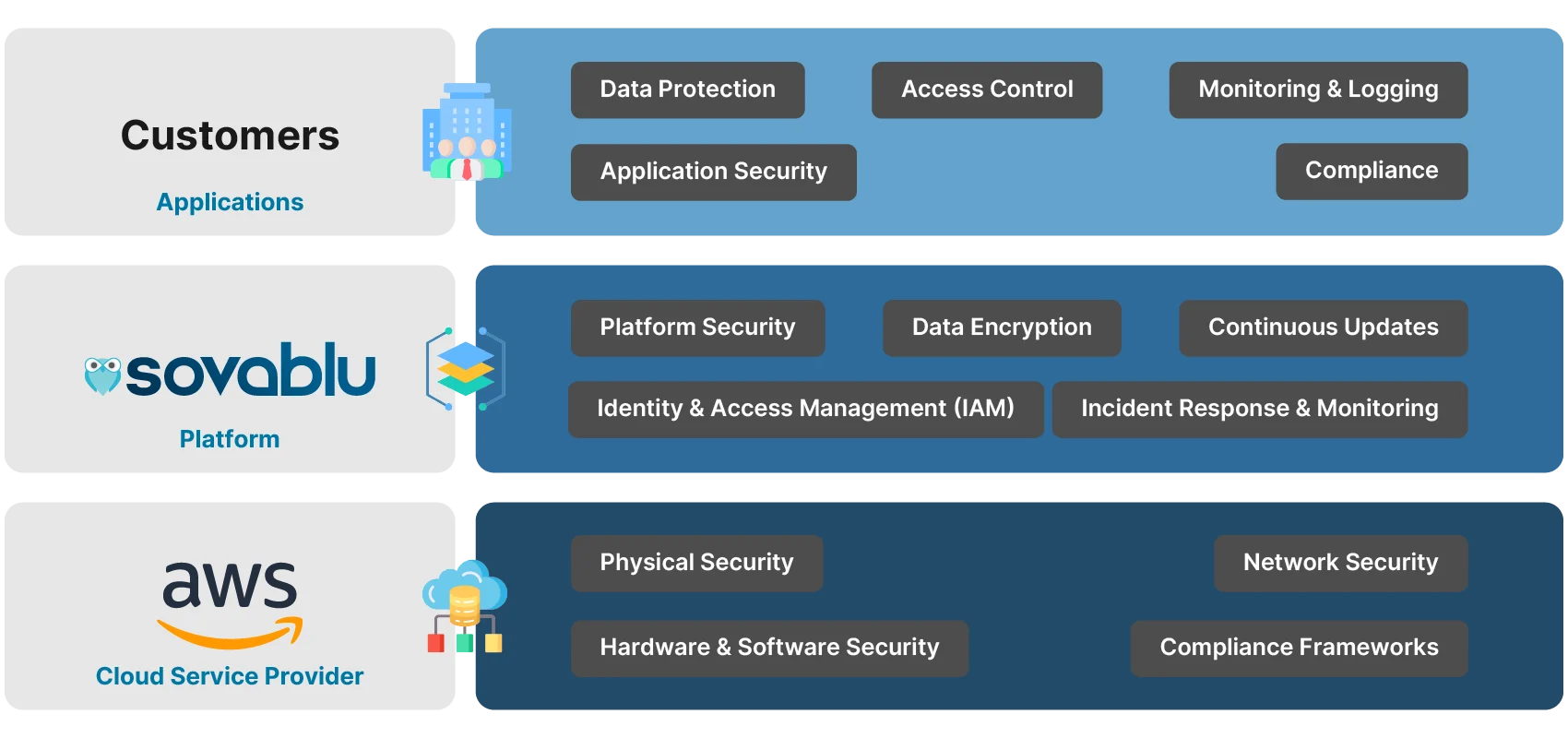
AWS provides the foundational security layer that Sovablu runs on. As a global cloud infrastructure provider, AWS maintains physical security across all data centers, network protection including intrusion detection and DDoS mitigation, hardware and software integrity across servers and virtualization layers, and compliance with a comprehensive list of global regulatory frameworks and certifications.
This means Sovablu operates on infrastructure that meets some of the highest security standards in the world without Sovablu or its customers needing to manage or verify that layer directly.
Sovablu is responsible for the security of the platform itself: how it is built, how it is maintained, and how it handles your data.
This includes platform security across all development, deployment, and operational processes. Data encryption in transit and at rest using AWS encryption mechanisms. Identity and Access Management with granular controls for user roles, permissions, and authentication. Continuous monitoring for platform-level threats with an incident response framework in place. Regular patching and updates to address emerging vulnerabilities before they reach your environment.
When you build on Sovablu, you are building on a platform that is actively maintained and tested against global security standards.
The Sovablu platform has also been assessed through independent VAPT (Vulnerability Assessment and Penetration Testing) in line with OWASP (Open Web Application Security Project) standards, including revalidation.
Sovablu gives your organization the tools to build and govern applications securely. How those tools are configured and used within your environment is your responsibility.
This covers five main aspects:
Data protection: implementing appropriate encryption, masking, and backup strategies for your application data.
Access control: defining role-based permissions so sensitive resources are accessible only to authorized individuals.
Application security: configuring application-level security features and addressing vulnerabilities in the applications you build.
Monitoring and logging: using Sovablu’s built-in monitoring capabilities to detect anomalies and maintain accountability.
Compliance: ensuring your applications meet your internal policies and any external regulatory requirements applicable to your organization, including GDPR, HIPAA, or SOC 2 where relevant.
Sovablu provides documentation and best practices to support your team in implementing these measures effectively.
Sovablu runs on AWS serverless infrastructure. AWS operates data centers across multiple global regions, including EU regions in Ireland and Frankfurt. Organizations with data residency requirements under GDPR or other regional regulations can work with Sovablu to ensure their deployment is configured to use AWS EU infrastructure.
Sovablu’s platform architecture includes role-based access control, audit logging, and data handling controls that align with the principles of GDPR: data minimization, access limitation, and accountability. While Sovablu continues to build its formal certification portfolio as a growing global platform, the platform is designed and operated in alignment with enterprise data privacy expectations.
For specific questions about data residency configuration or compliance requirements for your organization, contact our team directly.
The Shared Responsibility Model is not a disclaimer. It is a commitment to clarity. When every layer has defined ownership, your security posture is stronger, your audit trail is cleaner, and your teams can build with confidence knowing the foundation beneath them is solid.
AI on Sovablu is governed by architecture, not by policy documents. Every object GalaxyONE generates is visible and editable, never opaque code. Changes propagate with continuous validation, anything that needs human judgment is surfaced as a review for your team to approve, and role-based access and audit logging apply to AI-assisted work exactly as they apply to manual work.
Security ownership is explicit at every layer. AWS secures the cloud infrastructure: physical data centers, network protection, and hardware. Sovablu secures the platform itself: how it is built, maintained, and how it handles your data, including encryption and platform-level controls. Your organization secures what it builds on top: user roles, access policies, and how your applications handle your business data. This is the Shared Responsibility Model, and it means nothing falls through the gaps.
Yes. Sovablu runs on AWS serverless infrastructure, which operates data centers across global regions including EU regions in Ireland and Frankfurt. Organizations with data residency requirements under GDPR or other regional regulations can work with Sovablu to configure their deployment on AWS EU infrastructure.
Role-based access control is built into the platform. Your team defines roles and permissions for every application, down to the data and actions each role can reach. Access decisions are recorded in audit logs, so accountability is maintained across every application you run.
Sovablu’s architecture includes role-based access control, audit logging, and data handling controls that align with the principles of GDPR: data minimization, access limitation, and accountability. Sovablu continues to build its formal certification portfolio as a growing global platform, and the platform is designed and operated in alignment with enterprise data privacy expectations.
GalaxyONE, the AI engine inside Sovablu, operates inside the same governance as the rest of the platform. Every AI-generated object lands as visible, editable content, never as opaque code. Changes propagate with continuous validation, and anything that needs human judgment is surfaced as a review and a next action for your team to approve. Role-based access and audit logging apply to AI-assisted work exactly as they apply to manual work.
