
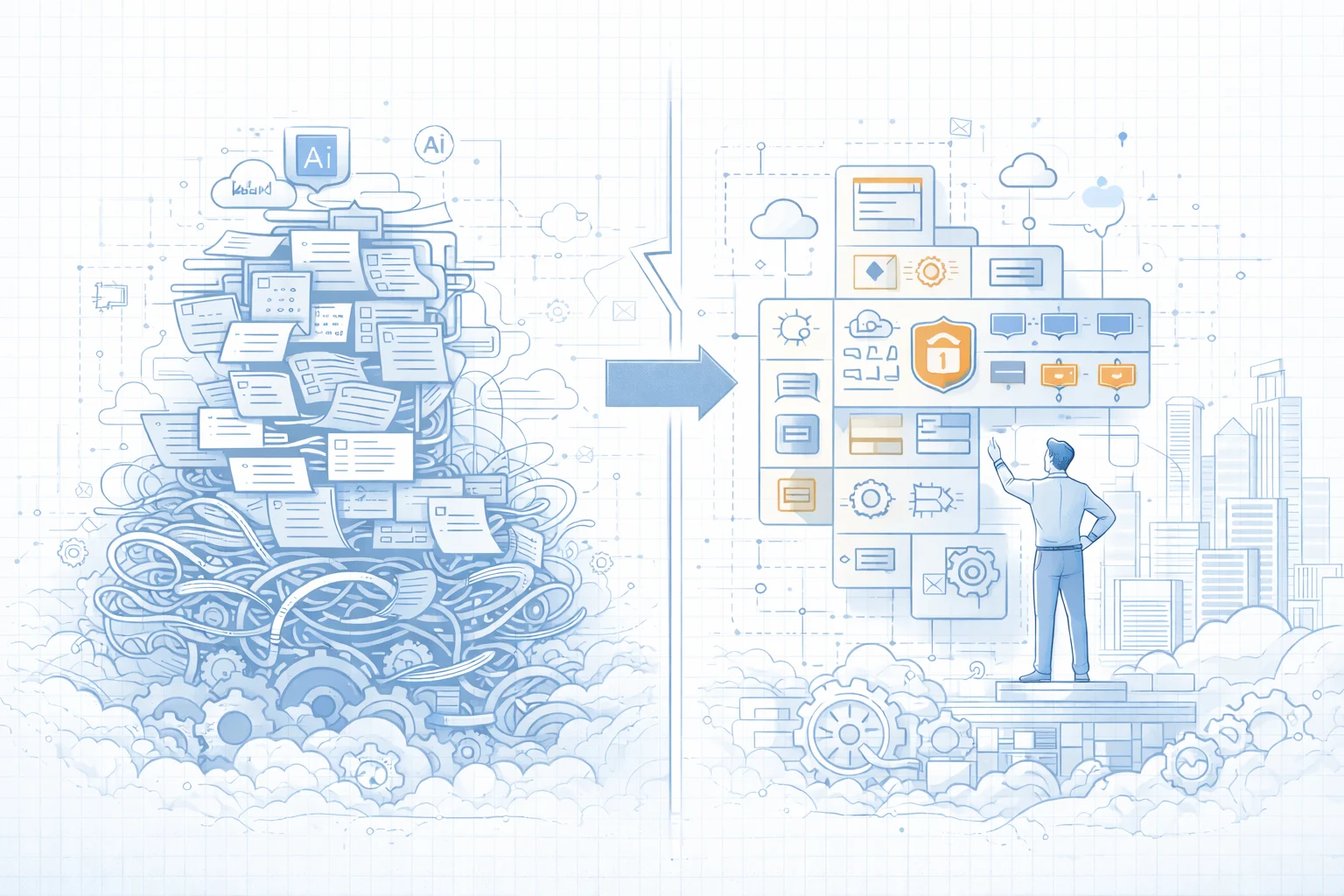

The recent market volatility surrounding Anthropic’s “Cowork” and agentic updates has sparked a global debate about the “end of software development”, or “SaaS-Pocalypse” according to many online sources. While the ability for AI to generate raw code or navigate a desktop is a significant technical milestone, it is not fundamentally new. AI generation of source code has been available for quite some time, moving from simple autocomplete to full-file generation over the last 4 to 5 years.
The current market tremor, which wiped billions off software stocks earlier this week, is a reaction to the scale of this generation and the sudden realization that more code does not equal more value. We are moving into an era where the distinction between a “productivity toy” that writes scripts and an “enterprise engine” that builds systems will not only become more obvious, but will also determine the success (or collapse) of many enterprise offerings.
The Rise of Comprehension Debt
The software industry is currently confronting a structural crisis known as Comprehension Debt. This is the ever growing gap between the massive volume of code an AI can (and does) generate and a human team’s ability to actually understand, maintain, and secure it (often an impossible task).
Traditional technical debt occurs when developers take shortcuts to save time. Comprehension Debt is more insidious, and occurs when a team of developers integrates thousands of lines of code that is syntactically correct, but semantically opaque. Since the developers did not build the logic themselves step by step (which would have given them intrinsic understanding of what is created), they lack the deep mental model required to troubleshoot the code when it fails.
We are increasingly witnessing a trend where even though AI speeds up initial creation of code, it has led to a significant drop in the actual productivity of experienced developers. Developers and software experts now spend countless hours as “forensic janitors” for AI-generated code slop. For an enterprise, a “productivity toy” that generates raw source code is a liability that (possibly) saves hours today but creates weeks or even months of debugging debt 18 months from now.
Sovablu AI: Solving the Debt with Intent Mapping
At Sovablu, we anticipated this shift at a very early stage, and focused our roadmap towards moving right to the top of the enterprise value chain. Instead of using AI to generate more raw code, which only ads to the debt, Sovablu uses AI to eliminate the need for manual coding in the final product.
The platform functions through a process of semantic mapping. When a user provides system specifications, legacy source code, or UI designs, Sovablu does not act as a junior programmer guessing the next line of syntax. Instead, it acts as an architect. It interprets the business intent (what does the user really want to create?) and maps it directly to Sovablu’s library of built-in, pre-verified logic blocks and actions. So, Sovablu is not generating a zillion lines of random code slop. Instead, it is using intelligent logical actions to identify the problem that needs to be solved, and delivers the actual solution. The end result is clean, efficient, easy to maintain and extremely flexible for future changes in business needs.
The Great Decoupling: Moving to the Top of the Value Chain
The software industry is currently undergoing a great decoupling, where the act of writing code is becoming a commodity with diminishing returns. To understand Sovablu’s position, one must look at the evolution of how we build.
We began in the manual era, where development was treated like a traditional craft. Large teams of programmers used text-based IDEs to write every line of code by hand. While this allowed for precision (at least in theory!), it lacked the scalability required for modern, rapidly changing, enterprise demands.
We then transitioned into the current generative era. Numerous AI tools turned coding into a high-speed text generation task. However, because the output is still just AI code in raw text format, these tools remain productivity toys. They may help individuals work faster, but they do not solve the underlying complexity or maintenance issues of a large organization.
Sovablu represents the move into the architectural era. Here, the primary tool is no longer a text editor but a sophisticated and highly intuitive platform that is accelerated by AI playing the role of the orchestrator. The output is a functional, Cloud-native application with modern user interfaces, clean data models and structured logic. The underlying architecture provides verified, reusable logical blocks that come together to form a cohesive system. This is the hallmark of an enterprise engine. It shifts the focus from the mundane task of writing source code, to the strategy of application architecture and visual thinking. And application architecture is the only high-value tier left in a world where AI can write syntax for free.
The Game-Changing Enterprise Engine
What truly separates Sovablu as an enterprise engine is how it absorbs complexity rather than exposing it. In the agentic era, Sovablu serves as the governance shell that general-purpose AI models lack.
- Inherent Governance: Because the actions within Sovablu are pre-audited and standardized, Sovablu AI cannot accidentally introduce common security vulnerabilities like SQL injection or broken access control. The security is an inherent property of the architecture itself, and not dependent on the precision of the prompt.
- Structural Integrity: Mapping to fixed logic blocks ensures that the application remains stable and scalable. There are no hallucinated code blocks or loops or memory leaks to track down because the underlying actions are already optimized and easy to understand.
- End-to-End Lifecycle Automation: Beyond just delivering the logic, Sovablu handles the entire lifecycle – data modeling, UI layout, and one-click cloud deployment. It is a comprehensive, one-stop platform, and not a basic code generator.
- Legacy Modernization: Sovablu can ingest legacy code and migrate it into clean, visual logic blocks. This restores the team’s comprehension of how their own business logic works, turning black box legacy systems into transparent, manageable, future-proof enterprise applications.
The ROI Shift: Consumption-Based Performance
The final pillar of the enterprise engine is a departure from the restrictive pricing of traditional software. Most legacy and SaaS platforms rely on per-user or per-seat licensing, which often penalizes growth and leads to wasteful expenditure.
Sovablu follows a pay-for-what-you-use pricing model. By removing the per-seat barrier, Sovablu creates a fundamental shift in Total Cost of Ownership (TCO) and real-world ROI:
- Aligned Value: Organizations only pay for the actual platform resources they utlize, ensuring that costs stay synchronized with use.
- Frictionless Scaling: You can deploy an application to five users or five thousand without a linear increase in licensing fees, allowing for broader adoption without artificial barriers and sky-rocketing costs.
- Lower Entry Risk: This model minimizes the upfront investment typically required for enterprise software, allowing teams to start small and scale naturally as their businesses grow.
In an era where the utilization of every dollar is under scrutiny, Sovablu ensures that your budget is spent on tangible business outcomes and not on headcounts.
To wrap this up, let’s just say that what’s happening now is not signaling the end of software. We believe that it is signaling the end of source code as the primary unit of value. The Sovablu model demonstrates that the future of the enterprise lies in platforms that prioritize architectural intent over raw, uncontrolled automation. By leveraging Sovablu and its AI capabilities, organizations can finally move beyond the limitations and liabilities of AI-generated code.
Explore how Sovablu can deliver radical digital transformation for a more secure and stress-free enterprise future. Request a demo now.